Skin Cancer: Know the Signs, Protect Your Skin
By Roberto Iglesias, MD, FACS, General Surgeon
Skin cancer is the most common cancer in the United States. According to the American Academy of Dermatology (AAD), about 1 in 5 Americans will develop skin cancer in their lifetime. The good news is that most skin cancers are very treatable when caught early, and many can be prevented. Here is what you need to know, in plain English.
The three main types
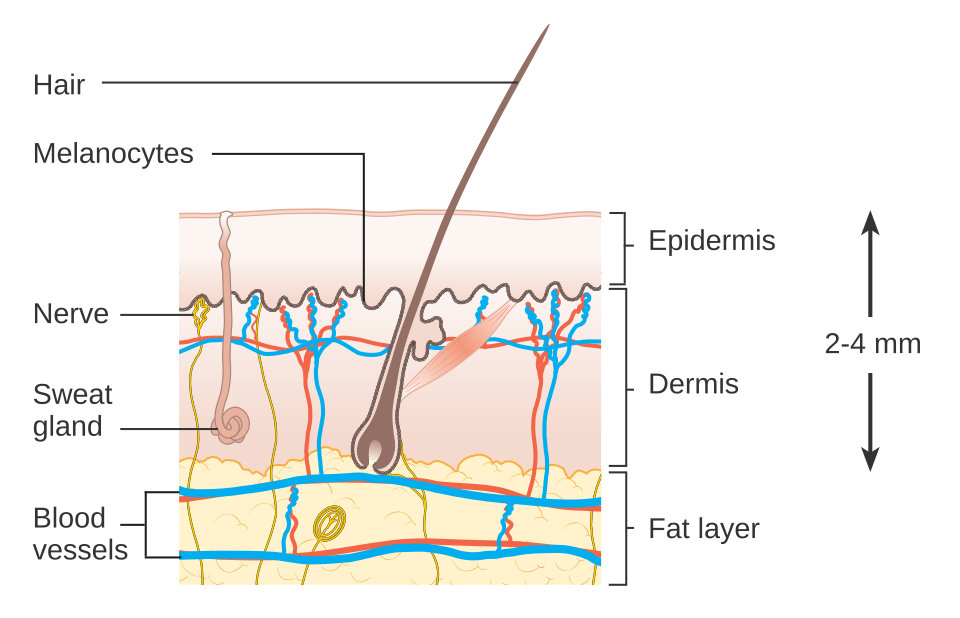
Skin cancers start in the top layer of the skin (the epidermis), shown in the diagram.
- Basal cell carcinoma (BCC): the most common type. It often looks like a pearly or shiny bump, a pink patch, or a sore that bleeds, scabs, and never quite heals. It grows slowly and very rarely spreads, but it can damage nearby tissue if left alone.
- Squamous cell carcinoma (SCC): the second most common. It often looks like a rough, scaly red patch, a firm bump, or a sore that doesn't heal, usually on sun-exposed skin. It is more likely than BCC to spread if neglected.
- Melanoma: less common but the most serious, because it can spread to lymph nodes and other organs. According to the AAD, most skin cancer deaths are from melanoma. Caught before it spreads to the lymph nodes, the five-year survival rate is 99%.
Warning signs: the ABCDEs of melanoma
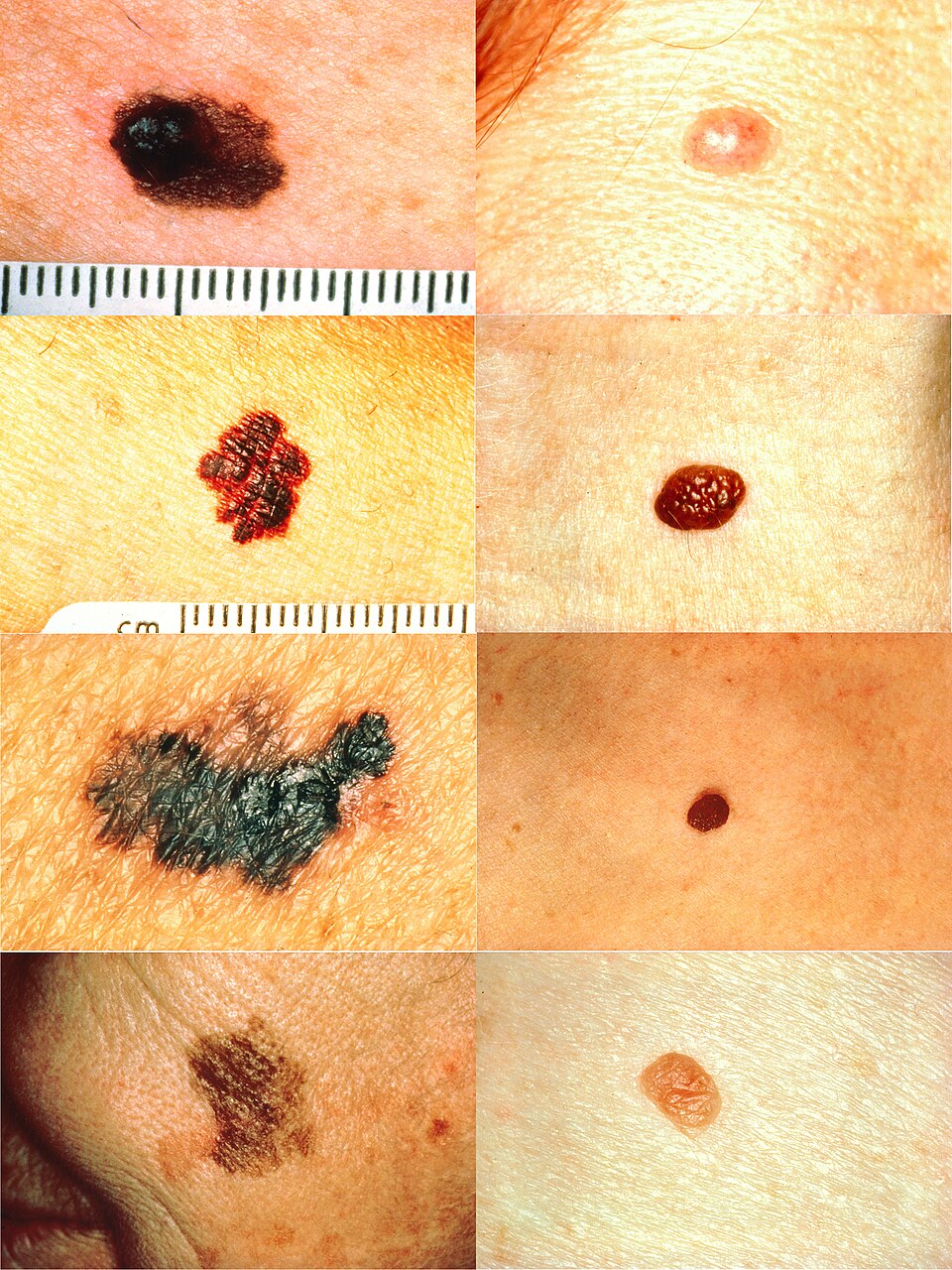
The AAD recommends checking your moles for these signs:
- A – Asymmetry: one half doesn't match the other.
- B – Border: edges are irregular, ragged, or blurred.
- C – Color: uneven shades of brown, black, tan, red, white, or blue.
- D – Diameter: larger than about 6 mm (the size of a pencil eraser), though melanomas can be smaller.
- E – Evolving: any change in size, shape, color, or height, or new itching, bleeding, or crusting.
Also watch for the "ugly duckling": a spot that looks different from your other moles. And for any type of skin cancer, see a doctor for a new growth or a sore that doesn't heal.
According to the AAD, people with darker skin can get skin cancer in places that see little sun, such as the palms, soles, and under the nails.
Who is at higher risk?
According to the AAD and the American Cancer Society, risk is higher if you have:
- Skin that burns easily, blonde or red hair, or light eyes
- A lot of sun exposure or a history of sunburns, especially blistering burns in childhood or the teen years
- Used tanning beds
- More than 50 moles, unusual (atypical) moles, or large moles
- A personal or family history of skin cancer
- A weakened immune system, such as after an organ transplant
Skin cancer can affect anyone, of any skin color.
Protecting your skin
The AAD recommends:
- Seek shade, especially in the middle of the day.
- Wear protective clothing: long sleeves, pants, a wide-brimmed hat, and UV-blocking sunglasses.
- Use a broad-spectrum, water-resistant sunscreen with SPF 30 or higher on all uncovered skin, and reapply about every 2 hours and after swimming or sweating.
- Avoid tanning beds.
- Check your own skin regularly, including your back (use a mirror or ask a partner) and your scalp, palms, and soles. About half of melanomas are first found by patients themselves.
Biopsy: the only way to know for sure
If a spot looks suspicious, the next step is a biopsy. After numbing the skin with a small injection, part or all of the spot is removed and sent to a pathologist, who looks at it under a microscope. Depending on the spot, this may be a shave, punch, or excisional biopsy. The results tell us exactly what it is and, for melanoma, how deep it goes, which guides treatment.
Treatment
- Surgical excision: the cancer is cut out along with a margin of normal-looking skin around it, and the wound is closed with stitches. The size of the margin depends on the type of cancer and, for melanoma, how thick it is. The tissue is checked to make sure the edges are clear.
- Mohs surgery: often used for BCC and SCC on the face, ears, hands, or other delicate areas, or for larger or recurring cancers. Thin layers are removed one at a time and checked under the microscope during the visit, until no cancer is left. This saves as much healthy skin as possible. Mohs is performed by specially trained dermatologic surgeons, and I'm happy to refer you when it's the best fit.
- Other options for some small, superficial BCCs and SCCs include scraping and burning (curettage and electrodesiccation), prescription creams, or radiation.
- Sentinel lymph node biopsy for melanoma: according to the National Cancer Institute, for some melanomas (based on their thickness and other features) we check whether cancer has reached the lymph nodes. A small amount of tracer is injected near the melanoma to find the first lymph node(s) it drains to, and those nodes are removed through a small incision and examined. This helps stage the cancer and plan any further treatment.
In my practice, I perform wide excisions and sentinel lymph node biopsies for melanoma, and I work closely with dermatology and oncology so that you have one coordinated plan.
Follow-up
Once you've had a skin cancer, you are at higher risk of getting another one. According to the AAD, melanoma survivors have about 8 times the general population's risk of a new melanoma. That's why regular skin checks and monthly self-exams matter. How often you are seen depends on the type and stage of your cancer; we'll set a schedule together.
When to call
Call your doctor or my office if you notice:
- A mole or spot that changes in size, shape, or color
- A new spot that looks different from your others
- A sore that bleeds or doesn't heal within a few weeks
- After surgery: fever, spreading redness, pus, or bleeding that won't stop with pressure
The bottom line
Most skin cancers are found by looking. Protect your skin, check it regularly, and don't ignore a spot that's new, changing, or not healing. Caught early, skin cancer is very treatable. If something worries you, I'm happy to take a look.
— Roberto Iglesias, MD, FACS
This article is for general education and is not a substitute for personal medical advice.
Sources
- American Academy of Dermatology. Skin cancer statistics.
- American Academy of Dermatology. What to look for: ABCDEs of melanoma.
- American Academy of Dermatology. Types of skin cancer.
- American Cancer Society. Melanoma skin cancer.
- National Cancer Institute. Melanoma treatment (PDQ), patient version.
Want to read more? The American Academy of Dermatology's skin cancer pages are written for patients and have helpful photos.
Image credits
Cáncer de piel: conozca las señales y proteja su piel
Por Roberto Iglesias, MD, FACS, Cirujano General
El cáncer de piel es el cáncer más común en los Estados Unidos. Según la Academia Americana de Dermatología (AAD), cerca de 1 de cada 5 estadounidenses tendrá cáncer de piel en algún momento de su vida. La buena noticia es que la mayoría de los cánceres de piel son muy tratables si se detectan a tiempo, y muchos se pueden prevenir. Aquí le explico lo que necesita saber, en palabras sencillas.
Los tres tipos principales
Los cánceres de piel comienzan en la capa superior de la piel (la epidermis), que se ve en el diagrama (rótulos en inglés).
- Carcinoma de células basales (basocelular): el tipo más común. A menudo parece un bultito perlado o brillante, una mancha rosada o una llaga que sangra, forma costra y nunca termina de sanar. Crece despacio y muy rara vez se extiende, pero puede dañar el tejido cercano si no se trata.
- Carcinoma de células escamosas (espinocelular): el segundo más común. A menudo parece una mancha roja, áspera y escamosa, un bulto firme o una llaga que no sana, por lo general en piel expuesta al sol. Es más probable que se extienda que el basocelular si no se atiende.
- Melanoma: menos común pero el más grave, porque puede extenderse a los ganglios linfáticos y a otros órganos. Según la AAD, la mayoría de las muertes por cáncer de piel se deben al melanoma. Si se detecta antes de llegar a los ganglios, la supervivencia a cinco años es del 99%.
Señales de alarma: el ABCDE del melanoma
La AAD recomienda revisar sus lunares buscando estas señales:
- A – Asimetría: una mitad no es igual a la otra.
- B – Bordes: irregulares, dentados o borrosos.
- C – Color: tonos desiguales de café, negro, beige, rojo, blanco o azul.
- D – Diámetro: mayor de unos 6 mm (el tamaño del borrador de un lápiz), aunque los melanomas pueden ser más pequeños.
- E – Evolución: cualquier cambio de tamaño, forma, color o altura, o nueva comezón, sangrado o costra.
Fíjese también en el "patito feo": una mancha que se ve diferente a sus otros lunares. Y para cualquier tipo de cáncer de piel, consulte a un médico por un crecimiento nuevo o una llaga que no sana.
Según la AAD, las personas de piel más oscura pueden tener cáncer de piel en lugares que reciben poco sol, como las palmas de las manos, las plantas de los pies y debajo de las uñas.
¿Quién tiene mayor riesgo?
Según la AAD y la Sociedad Americana Contra el Cáncer, el riesgo es mayor si usted:
- Tiene piel que se quema fácilmente, cabello rubio o pelirrojo, u ojos claros
- Ha tenido mucha exposición al sol o quemaduras de sol, sobre todo quemaduras con ampollas en la niñez o la adolescencia
- Ha usado camas de bronceado
- Tiene más de 50 lunares, lunares atípicos o lunares grandes
- Tiene antecedentes personales o familiares de cáncer de piel
- Tiene el sistema inmunitario debilitado, por ejemplo después de un trasplante de órgano
El cáncer de piel puede afectar a cualquier persona, de cualquier color de piel.
Cómo proteger su piel
La AAD recomienda:
- Buscar la sombra, sobre todo al mediodía.
- Usar ropa protectora: mangas largas, pantalones, sombrero de ala ancha y lentes de sol con protección UV.
- Usar un protector solar de amplio espectro, resistente al agua, con FPS 30 o más en toda la piel descubierta, y volver a aplicarlo cada 2 horas y después de nadar o sudar.
- Evitar las camas de bronceado.
- Revisar su propia piel con regularidad, incluyendo la espalda (con un espejo o con ayuda de su pareja), el cuero cabelludo, las palmas y las plantas. Cerca de la mitad de los melanomas los descubren los propios pacientes.
La biopsia: la única forma de saberlo con certeza
Si una mancha se ve sospechosa, el siguiente paso es una biopsia. Después de adormecer la piel con una pequeña inyección, se retira una parte o toda la mancha y se envía a un patólogo, quien la examina bajo el microscopio. Según la mancha, puede ser una biopsia por rasurado, por sacabocado (punch) o escisional. El resultado nos dice exactamente qué es y, en el melanoma, qué tan profundo llega, lo que guía el tratamiento.
Tratamiento
- Extirpación quirúrgica: se corta el cáncer junto con un margen de piel de aspecto normal a su alrededor, y la herida se cierra con puntos. El tamaño del margen depende del tipo de cáncer y, en el melanoma, de su grosor. El tejido se revisa para confirmar que los bordes estén libres.
- Cirugía de Mohs: se usa a menudo para el basocelular y el espinocelular en la cara, orejas, manos u otras áreas delicadas, o para cánceres grandes o que regresan. Se retiran capas delgadas una por una y se revisan al microscopio durante la misma visita, hasta que no queda cáncer. Así se conserva la mayor cantidad posible de piel sana. La realizan cirujanos dermatológicos con entrenamiento especial, y con gusto le refiero cuando sea la mejor opción.
- Otras opciones para algunos cánceres basocelulares y espinocelulares pequeños y superficiales incluyen raspado y cauterización (curetaje y electrodesecación), cremas recetadas o radiación.
- Biopsia del ganglio centinela en el melanoma: según el Instituto Nacional del Cáncer, en algunos melanomas (según su grosor y otras características) revisamos si el cáncer ha llegado a los ganglios linfáticos. Se inyecta una pequeña cantidad de marcador cerca del melanoma para encontrar el primer o primeros ganglios a los que drena, y esos ganglios se retiran por una incisión pequeña y se examinan. Esto ayuda a determinar la etapa del cáncer y planear cualquier tratamiento adicional.
En mi práctica, realizo extirpaciones amplias y biopsias del ganglio centinela para el melanoma, y trabajo de cerca con dermatología y oncología para que usted tenga un solo plan coordinado.
Seguimiento
Una vez que ha tenido cáncer de piel, usted tiene mayor riesgo de tener otro. Según la AAD, quienes han tenido melanoma tienen cerca de 8 veces el riesgo de la población general de tener un nuevo melanoma. Por eso son importantes las revisiones de la piel regulares y los autoexámenes mensuales. La frecuencia de sus citas depende del tipo y la etapa de su cáncer; fijaremos un plan juntos.
Cuándo llamar
Llame a su médico o a mi consultorio si nota:
- Un lunar o mancha que cambia de tamaño, forma o color
- Una mancha nueva que se ve diferente a las demás
- Una llaga que sangra o no sana en pocas semanas
- Después de la cirugía: fiebre, enrojecimiento que se extiende, pus, o sangrado que no se detiene con presión
En resumen
La mayoría de los cánceres de piel se descubren mirando. Proteja su piel, revísela con regularidad y no ignore una mancha nueva, que cambia o que no sana. Detectado a tiempo, el cáncer de piel es muy tratable. Si algo le preocupa, con gusto lo reviso.
— Roberto Iglesias, MD, FACS
Este artículo es para educación general y no sustituye el consejo médico personal.
Fuentes
- American Academy of Dermatology. Estadísticas del cáncer de piel (en inglés).
- American Academy of Dermatology. El ABCDE del melanoma (en inglés).
- American Academy of Dermatology. Tipos de cáncer de piel (en inglés).
- Sociedad Americana Contra el Cáncer. Cáncer de piel tipo melanoma.
- Instituto Nacional del Cáncer. Tratamiento del melanoma (PDQ), versión para pacientes (en inglés).
¿Quiere leer más? La página de MedlinePlus sobre el cáncer de piel está en español y escrita para pacientes.
Créditos de imágenes

