Colon Cancer Screening and Colonoscopy: A Patient's Guide
By Roberto Iglesias, MD, FACS, General Surgeon
Colon cancer is one of the few cancers we can often prevent, not just catch early. That's because most colon cancers start as small growths called polyps, and we can find and remove them before they ever turn into cancer. Here's what you need to know about screening, in plain English.
Why screening matters
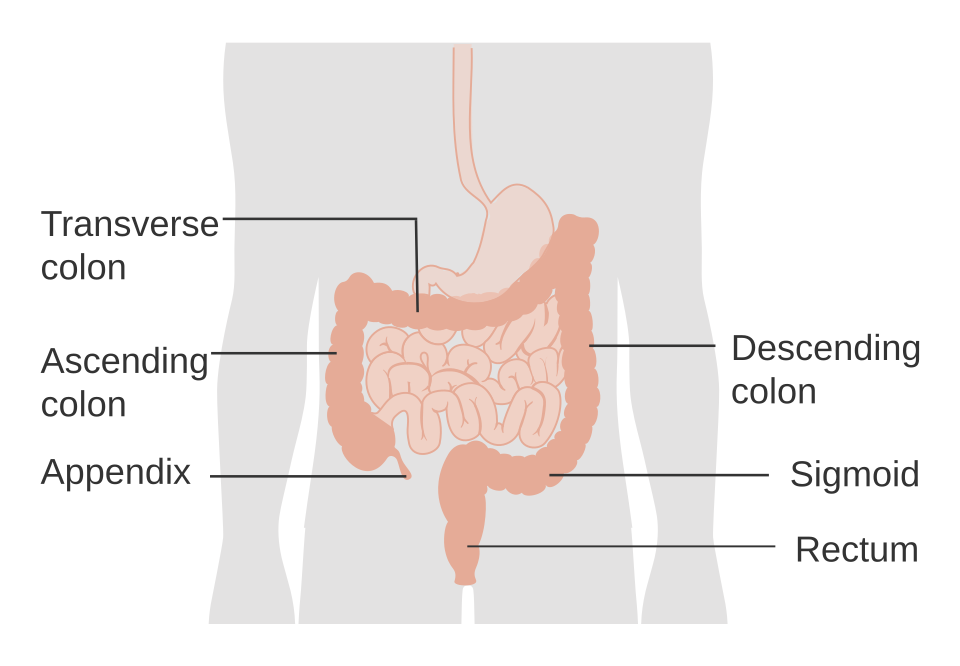
According to the U.S. Preventive Services Task Force (USPSTF), colorectal cancer is the third leading cause of cancer death for both men and women in the U.S. Many people with early colon cancer or polyps have no symptoms at all. That's exactly why we screen: to find problems while they are small and treatable.
(The diagram shows the large bowel, or colon, and the rectum, the parts a colonoscopy looks at.)
When to start
- The USPSTF (2021) recommends screening for all adults ages 45 to 75 who are at average risk.
- From 76 to 85, screening is a personal decision based on your health, your past screening, and your preferences.
- After 85, screening is generally not recommended.
The American Cancer Society also recommends starting at 45.
Start earlier, or get a diagnostic test instead, if you:
- Have a parent, brother, sister, or child with colorectal cancer or advanced polyps. The U.S. Multi-Society Task Force suggests starting at age 40, or 10 years before the age your relative was diagnosed, whichever comes first.
- Have had polyps or colorectal cancer before
- Have ulcerative colitis or Crohn's disease
- Have an inherited condition like Lynch syndrome
- Have symptoms, such as rectal bleeding, a change in bowel habits, unexplained weight loss, belly pain, or iron-deficiency anemia. Screening tests are for people without symptoms. If you have symptoms, you need a diagnostic evaluation, usually a colonoscopy.
Your options
The USPSTF lists several good tests. The best test is the one that gets done.
| Test |
What it is |
How often (if normal) |
| Colonoscopy |
A camera looks at the whole colon; polyps are removed at the same time |
Every 10 years |
| FIT (stool test) |
Checks a stool sample at home for hidden blood |
Every year |
| Stool DNA-FIT (Cologuard) |
Checks stool at home for blood and abnormal DNA |
Every 1 to 3 years |
| CT colonography ("virtual colonoscopy") |
A CT scan of the colon; still needs a bowel prep |
Every 5 years |
| Flexible sigmoidoscopy |
A shorter scope that looks at the lower colon |
Every 5 years (or every 10 years plus yearly FIT) |
Important: if a stool test or CT colonography is abnormal, you'll need a colonoscopy to finish the job. Without that follow-up, the screening doesn't help.
In my practice, I usually recommend colonoscopy, because it can find and remove polyps in the same visit. But if you'd rather do a home stool test, that is a good choice too, and much better than no screening.
Getting ready: the prep
According to NIDDK, a good prep is what lets us clearly see the lining of your colon. You'll get written instructions. In general:
- Review your medicines with us, especially blood thinners, diabetes medicines, and iron.
- Eat low-fiber foods for a few days before (avoid whole grains, raw vegetables, beans, nuts, and seeds), if your instructions say so.
- Follow a clear-liquid diet the day before.
- Drink the bowel prep as directed. Your stool should end up clear or yellow and liquid.
- Arrange a ride home. You won't be allowed to drive after sedation.
My tip: chill the prep and drink it through a straw. A split dose (part the night before, part the morning of) usually works best.
What happens during a colonoscopy
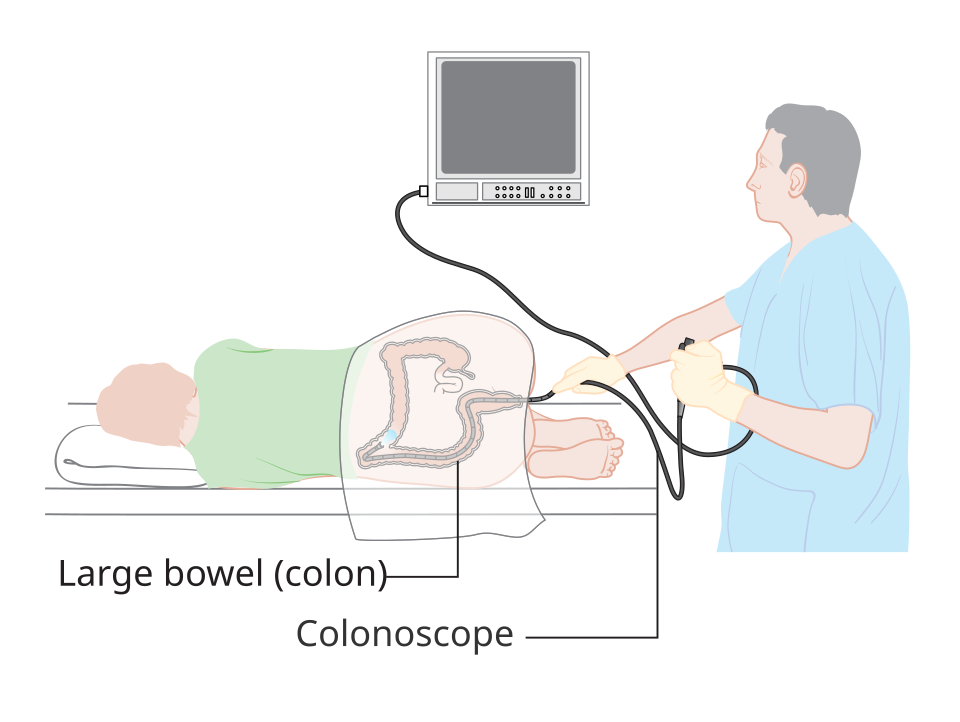
- You'll get sedation through an IV, so most people sleep through it or remember very little.
- You lie on your side. I gently pass a thin, flexible tube with a camera, the colonoscope, through the rectum and around the colon.
- A little air or carbon dioxide opens the colon so I can see it.
- If I find polyps, I usually remove them right then, painlessly, and send them to the lab.
- Afterward you may feel bloated or gassy for a few hours. Most people eat normally that day.
About polyps
- Polyps are small growths on the inner lining of the colon. Most are not cancer.
- Some kinds, called adenomas, can slowly turn into cancer over years. Removing them lowers your risk.
- The lab tells us what kind of polyp it was, which helps decide when you need your next colonoscopy.
Risks
Colonoscopy is very safe, but no procedure is risk-free. In the evidence reviewed by the USPSTF, for screening colonoscopy:
- Serious bleeding: about 15 per 10,000 procedures (often after a polyp is removed)
- Perforation (a tear in the colon): about 3 per 10,000 procedures
- Rare reactions to sedation
- The bowel prep can sometimes cause dehydration, especially in older adults
The risk of bleeding and perforation goes up with age.
When is my next one?
If your colonoscopy is normal and the prep was good, you'll usually need the next one in 10 years. If polyps were found, the U.S. Multi-Society Task Force (2020) recommends, for example:
- 1–2 small adenomas (under 10 mm): 7 to 10 years
- 3–4 small adenomas: 3 to 5 years
- 5–10 small adenomas, or an adenoma 10 mm or larger: 3 years
I'll give you your personal interval after the lab results are back.
When to call after a colonoscopy
Call 911 or go to the emergency room if you have:
- Severe belly pain, or a belly that becomes hard and swollen
- Heavy bleeding, or passing more than a small amount of blood or clots
- Fever with belly pain, chest pain, or trouble breathing
Call our office if you have:
- A small amount of bleeding that doesn't stop
- Dizziness or weakness
- Questions about your results or your next screening date
The bottom line
Screening saves lives, and starting at 45 gives you the best chance of preventing colon cancer. Whether you choose a colonoscopy or a home stool test, the most important step is to get screened. If you have symptoms or a family history, let's talk about starting sooner.
— Roberto Iglesias, MD, FACS
This article is for general education and is not a substitute for personal medical advice.
Sources
- U.S. Preventive Services Task Force. Colorectal Cancer: Screening (May 18, 2021).
- American Cancer Society. Guideline for Colorectal Cancer Screening.
- National Cancer Institute. Colorectal Cancer Screening (PDQ), Patient Version.
- NIDDK. Colonoscopy.
- Gupta S, et al. Recommendations for follow-up after colonoscopy and polypectomy: a consensus update by the US Multi-Society Task Force on Colorectal Cancer. Am J Gastroenterol. 2020;115(3):415–434. doi:10.14309/ajg.0000000000000544
Want to read more? NIDDK's Colonoscopy page explains the prep and the procedure clearly.
Image credits
Detección del cáncer de colon y colonoscopia: guía para pacientes
Por Roberto Iglesias, MD, FACS, cirujano general
El cáncer de colon es uno de los pocos cánceres que muchas veces podemos prevenir, no solo detectar a tiempo. Esto es porque la mayoría de los cánceres de colon empiezan como pequeños crecimientos llamados pólipos, y podemos encontrarlos y quitarlos antes de que se conviertan en cáncer. Aquí le explico lo que necesita saber sobre las pruebas de detección, en palabras sencillas.
Por qué son importantes las pruebas de detección
Según el Grupo de Trabajo de Servicios Preventivos de los EE. UU. (USPSTF), el cáncer colorrectal es la tercera causa de muerte por cáncer en hombres y en mujeres en los Estados Unidos. Muchas personas con cáncer de colon temprano o con pólipos no tienen ningún síntoma. Por eso hacemos pruebas de detección: para encontrar los problemas cuando todavía son pequeños y tratables.
(El diagrama muestra el intestino grueso, o colon, y el recto, las partes que revisa una colonoscopia.)
Cuándo empezar
- El USPSTF (2021) recomienda pruebas de detección para todos los adultos de 45 a 75 años con riesgo promedio.
- De los 76 a los 85, es una decisión personal según su salud, sus pruebas anteriores y sus preferencias.
- Después de los 85, por lo general no se recomienda.
La Sociedad Americana del Cáncer también recomienda empezar a los 45.
Empiece antes, o hágase una prueba de diagnóstico, si usted:
- Tiene un padre, madre, hermano, hermana o hijo con cáncer colorrectal o pólipos avanzados. El Grupo de Trabajo Multisociedad de los EE. UU. sugiere empezar a los 40 años, o 10 años antes de la edad en que le diagnosticaron a su familiar, lo que ocurra primero.
- Ha tenido pólipos o cáncer colorrectal antes
- Tiene colitis ulcerosa o enfermedad de Crohn
- Tiene una condición heredada como el síndrome de Lynch
- Tiene síntomas, como sangrado por el recto, un cambio en sus evacuaciones, pérdida de peso sin explicación, dolor de estómago o anemia por falta de hierro. Las pruebas de detección son para personas sin síntomas. Si tiene síntomas, necesita una evaluación diagnóstica, por lo general una colonoscopia.
Sus opciones
El USPSTF menciona varias pruebas buenas. La mejor prueba es la que sí se hace.
| Prueba |
Qué es |
Cada cuánto (si sale normal) |
| Colonoscopia |
Una cámara revisa todo el colon; los pólipos se quitan en el mismo momento |
Cada 10 años |
| FIT (prueba de heces) |
Revisa en casa una muestra de heces para buscar sangre oculta |
Cada año |
| ADN en heces con FIT (Cologuard) |
Revisa las heces en casa para buscar sangre y ADN anormal |
Cada 1 a 3 años |
| Colonografía por tomografía ("colonoscopia virtual") |
Una tomografía del colon; también necesita preparación intestinal |
Cada 5 años |
| Sigmoidoscopia flexible |
Un tubo más corto que revisa la parte baja del colon |
Cada 5 años (o cada 10 años más FIT cada año) |
Importante: si una prueba de heces o una colonografía sale anormal, necesitará una colonoscopia para completar el estudio. Sin ese seguimiento, la prueba de detección no sirve.
En mi práctica, por lo general recomiendo la colonoscopia, porque puede encontrar y quitar pólipos en la misma cita. Pero si prefiere una prueba de heces en casa, también es una buena opción, y mucho mejor que no hacerse ninguna prueba.
Prepararse: la limpieza intestinal
Según el NIDDK, una buena preparación es lo que nos permite ver con claridad el revestimiento del colon. Recibirá instrucciones por escrito. En general:
- Revise sus medicamentos con nosotros, sobre todo anticoagulantes, medicinas para la diabetes y el hierro.
- Coma alimentos bajos en fibra unos días antes (evite granos integrales, verduras crudas, frijoles, nueces y semillas), si sus instrucciones lo indican.
- Siga una dieta de líquidos claros el día anterior.
- Tome la preparación intestinal como se le indique. Sus evacuaciones deben quedar claras o amarillas y líquidas.
- Consiga quién lo lleve a casa. No podrá manejar después de la sedación.
Mi consejo: tome la preparación bien fría y con popote. Dividir la dosis (una parte la noche anterior y otra parte en la mañana) por lo general funciona mejor.
Qué pasa durante una colonoscopia
- Recibirá sedación por la vena, así que la mayoría de las personas se duermen o recuerdan muy poco.
- Se acuesta de lado. Con cuidado paso un tubo delgado y flexible con una cámara, el colonoscopio, por el recto y a lo largo del colon.
- Un poco de aire o dióxido de carbono abre el colon para que yo pueda ver.
- Si encuentro pólipos, por lo general los quito en ese momento, sin dolor, y los mando al laboratorio.
- Después puede sentirse inflamado o con gases por unas horas. La mayoría de las personas come normal ese día.
(El diagrama está en inglés: "Large bowel" es el intestino grueso y "Colonoscope" es el colonoscopio.)
Sobre los pólipos
- Los pólipos son pequeños crecimientos en el revestimiento interno del colon. La mayoría no son cáncer.
- Algunos tipos, llamados adenomas, pueden convertirse lentamente en cáncer con los años. Quitarlos baja su riesgo.
- El laboratorio nos dice qué tipo de pólipo era, lo que ayuda a decidir cuándo necesita su próxima colonoscopia.
Riesgos
La colonoscopia es muy segura, pero ningún procedimiento está libre de riesgo. En la evidencia revisada por el USPSTF, para la colonoscopia de detección:
- Sangrado grave: alrededor de 15 de cada 10,000 procedimientos (muchas veces después de quitar un pólipo)
- Perforación (una rotura del colon): alrededor de 3 de cada 10,000 procedimientos
- Reacciones poco comunes a la sedación
- La preparación a veces puede causar deshidratación, sobre todo en adultos mayores
El riesgo de sangrado y de perforación aumenta con la edad.
¿Cuándo me toca la próxima?
Si su colonoscopia sale normal y la preparación fue buena, por lo general la próxima será en 10 años. Si se encontraron pólipos, el Grupo de Trabajo Multisociedad de los EE. UU. (2020) recomienda, por ejemplo:
- 1–2 adenomas pequeños (menos de 10 mm): 7 a 10 años
- 3–4 adenomas pequeños: 3 a 5 años
- 5–10 adenomas pequeños, o un adenoma de 10 mm o más: 3 años
Le daré su intervalo personal cuando lleguen los resultados del laboratorio.
Cuándo llamar después de una colonoscopia
Llame al 911 o vaya a la sala de emergencias si tiene:
- Dolor fuerte de estómago, o el abdomen se pone duro e inflamado
- Sangrado abundante, o expulsa más que un poco de sangre o coágulos
- Fiebre con dolor de estómago, dolor de pecho o dificultad para respirar
Llame a nuestra oficina si tiene:
- Un poco de sangrado que no se detiene
- Mareo o debilidad
- Preguntas sobre sus resultados o la fecha de su próxima prueba
En resumen
Las pruebas de detección salvan vidas, y empezar a los 45 le da la mejor oportunidad de prevenir el cáncer de colon. Ya sea que escoja una colonoscopia o una prueba de heces en casa, el paso más importante es hacerse la prueba. Si tiene síntomas o antecedentes familiares, hablemos de empezar antes.
— Roberto Iglesias, MD, FACS
Este artículo es solo para educación general y no reemplaza el consejo médico personal.
Fuentes
- U.S. Preventive Services Task Force. Colorectal Cancer: Screening (18 de mayo de 2021, en inglés).
- American Cancer Society. Guideline for Colorectal Cancer Screening (en inglés).
- Instituto Nacional del Cáncer. Colorectal Cancer Screening (PDQ), Patient Version (en inglés).
- NIDDK. Colonoscopy (en inglés).
- Gupta S, et al. Recommendations for follow-up after colonoscopy and polypectomy: a consensus update by the US Multi-Society Task Force on Colorectal Cancer. Am J Gastroenterol. 2020;115(3):415–434. doi:10.14309/ajg.0000000000000544
¿Quiere leer más? MedlinePlus tiene una página en español sobre la colonoscopia.
Créditos de las imágenes

