Colon Surgery: What It's For and What to Expect
By Roberto Iglesias, MD, FACS, General Surgeon
Hearing that you need part of your colon removed can feel overwhelming. The good news is that colon surgery is a common operation, and today most of it is done through small incisions, with a faster recovery than in the past. Here's what you need to know, in plain English.
Why colon surgery may be needed
The colon (large bowel) absorbs water and stores stool. Surgery to remove part of it is called a colectomy or colon resection. Reasons fall into two broad groups.
Non-cancer (benign) reasons
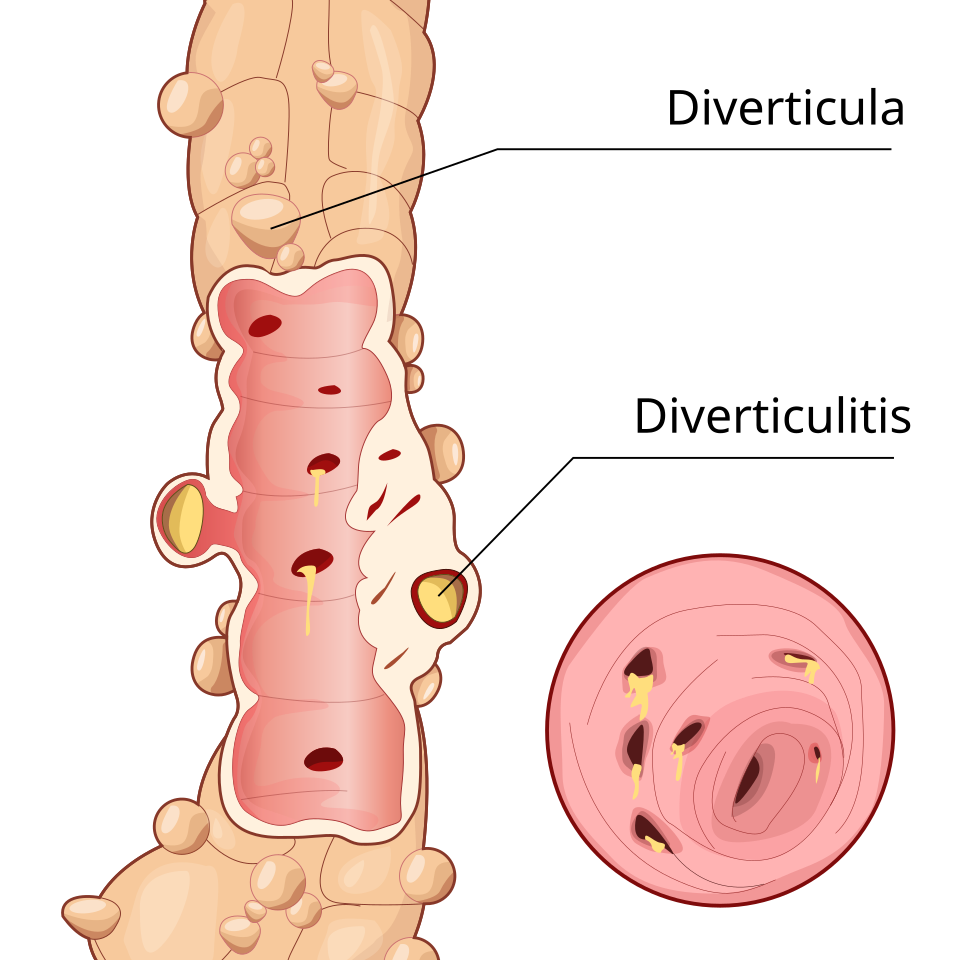
- Diverticulitis: small pouches in the colon wall (diverticula) become inflamed or infected. Most flares are treated without surgery. According to the American Society of Colon and Rectal Surgeons (ASCRS) 2020 guideline:
- After recovering from an uncomplicated flare, the decision to remove the colon should be individualized. It is no longer based on simply counting the number of attacks, and an operation done only to avoid a possible future colostomy is discouraged.
- Surgery is more often advised for complicated disease, such as an abscess, a fistula (an abnormal connection, for example to the bladder), a narrowing (stricture), or frequent flares that affect your quality of life. It is often urgent for a perforation with widespread infection.
- Things we weigh together: how often and how badly you flare, ongoing symptoms, your health and other conditions (such as a weak immune system), and your preferences.
- Large polyps that can't be safely removed through a colonoscope
- Inflammatory bowel disease (Crohn's disease or ulcerative colitis) that doesn't respond to medicine, or causes narrowing, bleeding, or precancerous changes
- Volvulus: a twist of the colon that cuts off its blood supply. It can be an emergency.
(The illustration shows diverticula, the small pouches in the colon wall that can become inflamed.)
Colon cancer
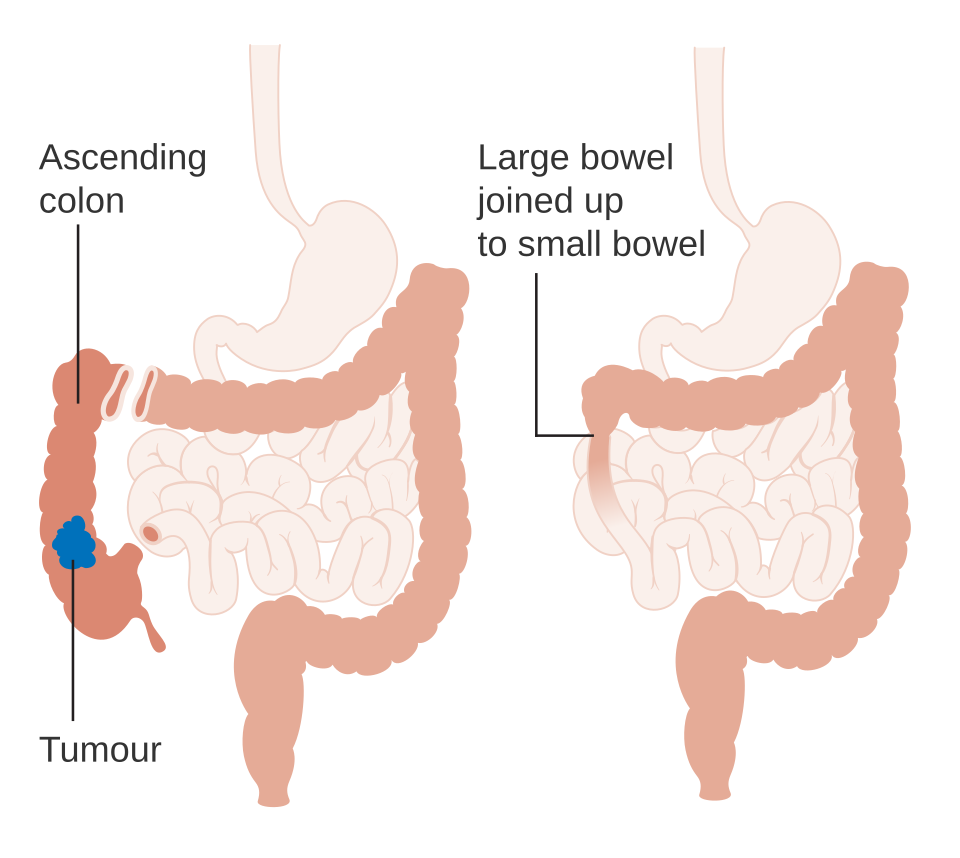
For cancer, the operation is more than just taking out the tumor. It's an oncologic resection:
- I remove the part of the colon with the tumor along with healthy margins and the fatty tissue (mesentery) that holds its blood vessels and lymph nodes.
- Lymph nodes are where cancer spreads first. The ASCRS 2022 guideline recommends that the lab examine at least 12 lymph nodes so your stage is accurate.
- Staging (stage I to IV) tells us how far the cancer has gone, based on how deep it grew, the lymph nodes, and any spread. It is usually checked before surgery with a CT scan and blood tests.
- Depending on the final stage, you may meet with a cancer doctor (medical oncologist) to discuss chemotherapy after surgery. According to NCI, chemotherapy is often recommended when cancer has reached the lymph nodes.
(The diagram shows a right hemicolectomy: the right side of the colon is removed, and the remaining colon is joined to the small bowel.)
How the surgery is done
- Laparoscopic or robotic surgery: a few small incisions, a camera, and long thin instruments. One slightly larger incision is used to take out the specimen. This is the usual approach for planned surgery.
- Open surgery: one larger incision. Sometimes it's the safest option, for example in some emergencies or after many prior operations.
- After removing the diseased part, I usually reconnect the two healthy ends. This connection is called an anastomosis.
A note from me about the robot: Sometimes I do this operation with the help of the surgical robot. Whether we use it depends on you: your body, your disease, and what will work best for you. Either way, it is still a minimally invasive operation through small incisions, and I am the one performing it. The robot does not operate on its own; it simply holds the instruments while I guide every move.
Enhanced recovery (ERAS)
We follow an enhanced recovery program, based on the ASCRS and SAGES 2023 guidelines, to help you heal faster. This usually includes:
- Before surgery: education, good nutrition, and often a carbohydrate drink a few hours before surgery. (Your exact prep instructions, including whether you take a bowel prep with oral antibiotics, will come from me.)
- During surgery: minimally invasive techniques when possible, and careful fluid and pain management
- After surgery: walking the same day or the next, eating early, and pain control that limits opioids
Will I need an ostomy?
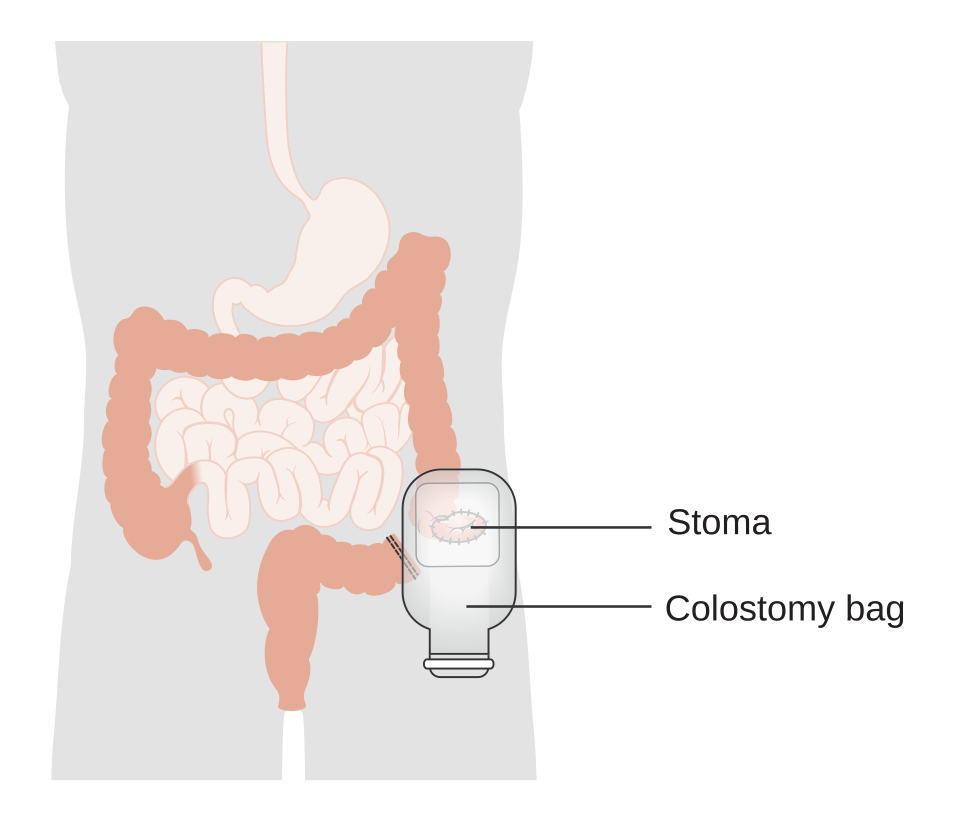
Most people do not need a permanent bag. But sometimes an ostomy is the safest choice:
- A colostomy or ileostomy brings the bowel out through a small opening on the belly (a stoma), and stool collects in a bag.
- It may be used in an emergency (such as a perforation), when there's a lot of infection, or to protect a new connection while it heals.
- Many ostomies are temporary and can be reversed with a smaller operation later.
If an ostomy is possible, we'll talk about it before surgery, and an ostomy nurse can help mark the best spot and teach you how to care for it.
Risks
Every operation has risks. With colon surgery, the main ones are:
- Anastomotic leak: the new connection doesn't heal completely and leaks. This is serious and may need antibiotics, a drain, or another operation.
- Infection, especially of the incisions or inside the belly
- Bleeding
- Ileus: the bowel is slow to "wake up," causing bloating and nausea
- Blood clots in the legs or lungs. We use preventive measures.
- Injury to nearby organs (rare)
Your personal risk depends on your health, your disease, and whether the surgery is planned or an emergency.
Recovery
- Hospital stay: often a few days after minimally invasive surgery, longer after open or emergency surgery. (This is my usual experience; it varies by patient.)
- Walking: start early and walk often.
- Eating: most people start eating soon after surgery. Small meals help at first.
- Bowel movements: may be irregular for a few weeks.
- Lifting: follow my specific limits while the incisions heal.
- Follow-up: we'll review your pathology results together. After cancer surgery, you'll need follow-up visits, scans, and colonoscopies.
When to call your surgeon
Call 911 right away if you have:
- Chest pain or trouble breathing
Call our office right away, or go to the emergency room after hours, if you have:
- Fever of 101°F (38.3°C) or higher, or chills
- Belly pain that is getting worse, not better
- Nausea or vomiting, or you can't keep liquids down
- A swollen, hard belly, or no gas or stool for more than a day
- Redness, drainage, or pus at an incision
- Bleeding from the rectum beyond a small amount
- Calf swelling or pain
- With an ostomy: no output, very high watery output, or a stoma that turns dark or black
The bottom line
Colon surgery treats problems ranging from diverticulitis to cancer. Most operations today are minimally invasive, with an enhanced recovery plan to get you home sooner. We'll decide together whether surgery is right for you, and I'll walk you through every step.
— Roberto Iglesias, MD, FACS
This article is for general education and is not a substitute for personal medical advice.
Sources
- Hall J, et al. The American Society of Colon and Rectal Surgeons clinical practice guidelines for the treatment of left-sided colonic diverticulitis. Dis Colon Rectum. 2020;63(6):728–747. doi:10.1097/DCR.0000000000001679
- Vogel JD, et al. The American Society of Colon and Rectal Surgeons clinical practice guidelines for the management of colon cancer. Dis Colon Rectum. 2022;65(2):148–177. doi:10.1097/DCR.0000000000002323
- Irani JL, et al. Clinical practice guidelines for enhanced recovery after colon and rectal surgery from the ASCRS and SAGES. Dis Colon Rectum. 2023;66(1):15–40. doi:10.1097/DCR.0000000000002650
- National Cancer Institute. Colon Cancer Treatment (PDQ), Patient Version.
- NIDDK. Diverticular Disease.
Want to read more? NCI's Colon Cancer Treatment page and NIDDK's Diverticular Disease page are written for patients.
Image credits
Cirugía de colon: para qué sirve y qué esperar
Por Roberto Iglesias, MD, FACS, cirujano general
Escuchar que necesita que le quiten parte del colon puede ser abrumador. La buena noticia es que la cirugía de colon es una operación común, y hoy la mayoría se hace con incisiones pequeñas, con una recuperación más rápida que en el pasado. Aquí le explico lo que necesita saber, en palabras sencillas.
Por qué se puede necesitar una cirugía de colon
El colon (intestino grueso) absorbe agua y guarda las heces. La cirugía para quitar una parte se llama colectomía o resección de colon. Las razones se dividen en dos grupos.
Razones que no son cáncer (benignas)
- Diverticulitis: pequeñas bolsitas en la pared del colon (divertículos) se inflaman o se infectan. La mayoría de los episodios se tratan sin cirugía. Según la guía de 2020 de la Sociedad Americana de Cirujanos de Colon y Recto (ASCRS):
- Después de recuperarse de un episodio no complicado, la decisión de quitar el colon debe ser individualizada. Ya no se basa simplemente en contar el número de ataques, y se desaconseja operar solo para evitar una posible colostomía en el futuro.
- La cirugía se recomienda más en la enfermedad complicada, como un absceso, una fístula (una conexión anormal, por ejemplo con la vejiga), un estrechamiento (estenosis), o episodios frecuentes que afectan su calidad de vida. Muchas veces es urgente si hay una perforación con infección extendida.
- Lo que valoramos juntos: qué tan seguido y qué tan fuerte le dan los episodios, los síntomas que persisten, su salud y otras condiciones (como un sistema inmune débil) y sus preferencias.
- Pólipos grandes que no se pueden quitar con seguridad por colonoscopia
- Enfermedad inflamatoria intestinal (enfermedad de Crohn o colitis ulcerosa) que no responde a los medicamentos, o que causa estrechamiento, sangrado o cambios precancerosos
- Vólvulo: el colon se tuerce y se corta su flujo de sangre. Puede ser una emergencia.
(La ilustración, en inglés, muestra los divertículos ("Diverticula"), las bolsitas en la pared del colon, y la diverticulitis ("Diverticulitis"), cuando se inflaman.)
Cáncer de colon
Para el cáncer, la operación es más que solo sacar el tumor. Es una resección oncológica:
- Quito la parte del colon con el tumor, con márgenes sanos, y el tejido graso (mesenterio) que contiene sus vasos sanguíneos y ganglios linfáticos.
- Los ganglios linfáticos son a donde primero se extiende el cáncer. La guía de la ASCRS de 2022 recomienda que el laboratorio revise al menos 12 ganglios linfáticos para que su etapa sea precisa.
- La estadificación (etapa I a IV) nos dice qué tan avanzado está el cáncer, según qué tan profundo creció, los ganglios y si se extendió. Por lo general se revisa antes de la cirugía con una tomografía y análisis de sangre.
- Según la etapa final, puede ver a un médico especialista en cáncer (oncólogo) para hablar de quimioterapia después de la cirugía. Según el NCI, muchas veces se recomienda quimioterapia cuando el cáncer llegó a los ganglios.
(El diagrama, en inglés, muestra una hemicolectomía derecha: se quita el lado derecho del colon, y el colon que queda se une al intestino delgado. "Tumour" es el tumor.)
Cómo se hace la cirugía
- Cirugía laparoscópica o robótica: unas pocas incisiones pequeñas, una cámara e instrumentos largos y delgados. Se usa una incisión un poco más grande para sacar la pieza. Es la técnica habitual para la cirugía planeada.
- Cirugía abierta: una incisión más grande. A veces es la opción más segura, por ejemplo en algunas emergencias o después de muchas operaciones previas.
- Después de quitar la parte enferma, por lo general vuelvo a unir los dos extremos sanos. Esta unión se llama anastomosis.
Una nota mía sobre el robot: A veces hago esta operación con la ayuda del robot quirúrgico. Usarlo o no depende de usted: de su cuerpo, de su enfermedad y de lo que mejor le convenga. De cualquier forma, sigue siendo una operación mínimamente invasiva con incisiones pequeñas, y soy yo quien la realiza. El robot no opera por sí solo; simplemente sostiene los instrumentos mientras yo guío cada movimiento.
Recuperación mejorada (ERAS)
Seguimos un programa de recuperación mejorada, basado en las guías de 2023 de la ASCRS y SAGES, para ayudarle a sanar más rápido. Por lo general incluye:
- Antes de la cirugía: educación, buena nutrición y muchas veces una bebida con carbohidratos unas horas antes. (Sus instrucciones exactas de preparación, incluyendo si toma una limpieza intestinal con antibióticos por boca, se las daré yo.)
- Durante la cirugía: técnicas mínimamente invasivas cuando es posible, y un manejo cuidadoso de los líquidos y del dolor
- Después de la cirugía: caminar el mismo día o al día siguiente, comer pronto, y un control del dolor que limita los opioides
¿Necesitaré una ostomía?
La mayoría de las personas no necesitan una bolsa permanente. Pero a veces una ostomía es la opción más segura:
- Una colostomía o ileostomía saca el intestino por una pequeña abertura en el abdomen (un estoma), y las heces se juntan en una bolsa.
- Se puede usar en una emergencia (como una perforación), cuando hay mucha infección, o para proteger una unión nueva mientras sana.
- Muchas ostomías son temporales y se pueden revertir después con una operación más pequeña.
Si es posible que necesite una ostomía, lo hablaremos antes de la cirugía, y una enfermera especialista en ostomías puede ayudar a marcar el mejor lugar y enseñarle a cuidarla.
(En el diagrama, "Stoma" es el estoma y "Colostomy bag" es la bolsa de colostomía.)
Riesgos
Toda operación tiene riesgos. En la cirugía de colon, los principales son:
- Fuga de la anastomosis: la unión nueva no sana por completo y se filtra. Es algo serio y puede necesitar antibióticos, un drenaje u otra operación.
- Infección, sobre todo de las heridas o dentro del abdomen
- Sangrado
- Íleo: el intestino tarda en "despertar", lo que causa inflamación y náuseas
- Coágulos en las piernas o los pulmones. Usamos medidas para prevenirlos.
- Lesión de órganos cercanos (poco común)
Su riesgo personal depende de su salud, su enfermedad y si la cirugía es planeada o de emergencia.
Recuperación
- Hospital: muchas veces unos pocos días después de una cirugía mínimamente invasiva, más tiempo después de una cirugía abierta o de emergencia. (Esta es mi experiencia habitual; varía según el paciente.)
- Caminar: empiece pronto y camine seguido.
- Comer: la mayoría de las personas empieza a comer poco después de la cirugía. Las comidas pequeñas ayudan al principio.
- Evacuaciones: pueden ser irregulares por unas semanas.
- Cargar peso: siga mis límites específicos mientras sanan las heridas.
- Seguimiento: revisaremos juntos los resultados de patología. Después de una cirugía por cáncer, necesitará citas de seguimiento, estudios de imagen y colonoscopias.
Cuándo llamar a su cirujano
Llame al 911 de inmediato si tiene:
- Dolor de pecho o dificultad para respirar
Llame a nuestra oficina de inmediato, o vaya a la sala de emergencias fuera del horario, si tiene:
- Fiebre de 101 °F (38.3 °C) o más, o escalofríos
- Dolor de estómago que empeora en vez de mejorar
- Náuseas o vómitos, o no puede tolerar líquidos
- El abdomen inflado y duro, o no ha expulsado gases ni evacuado en más de un día
- Enrojecimiento, secreción o pus en una herida
- Sangrado por el recto de más que un poco
- Hinchazón o dolor en la pantorrilla
- Con una ostomía: no sale nada, sale mucho líquido aguado, o el estoma se pone oscuro o negro
En resumen
La cirugía de colon trata problemas que van desde la diverticulitis hasta el cáncer. La mayoría de las operaciones hoy son mínimamente invasivas, con un plan de recuperación mejorada para que regrese a casa más pronto. Decidiremos juntos si la cirugía es lo correcto para usted, y le explicaré cada paso.
— Roberto Iglesias, MD, FACS
Este artículo es solo para educación general y no reemplaza el consejo médico personal.
Fuentes
- Hall J, et al. The American Society of Colon and Rectal Surgeons clinical practice guidelines for the treatment of left-sided colonic diverticulitis. Dis Colon Rectum. 2020;63(6):728–747. doi:10.1097/DCR.0000000000001679
- Vogel JD, et al. The American Society of Colon and Rectal Surgeons clinical practice guidelines for the management of colon cancer. Dis Colon Rectum. 2022;65(2):148–177. doi:10.1097/DCR.0000000000002323
- Irani JL, et al. Clinical practice guidelines for enhanced recovery after colon and rectal surgery from the ASCRS and SAGES. Dis Colon Rectum. 2023;66(1):15–40. doi:10.1097/DCR.0000000000002650
- Instituto Nacional del Cáncer. Tratamiento del cáncer de colon (PDQ), versión para pacientes.
- NIDDK. Diverticular Disease (en inglés).
¿Quiere leer más? El Instituto Nacional del Cáncer tiene información en español sobre el tratamiento del cáncer de colon.
Créditos de las imágenes


